

Ofcom tested mobile signal on 24 UK rail lines. We take a look where it actually breaks down, and how to plan around it.
Ofcom, working with the testing firm Streetwave, ran 50 journeys across 24 rail lines in England, Scotland and Wales between February and March 2026, the most thorough look yet at what mobile sinyal on UK trains is like, rather than what coverage maps say it should be [1]. A connection counted as “good performance” only if it hit at least 5Mbps download, 1.5Mbps upload and under 50ms latency, a bar meant to reflect what you’d need for a video call or a work upload, not just a bar of signal on your screen [1].
By that measure, performance was poor on well over half of journeys tested, and the gap between the best and worst stretches of track was substantial. We looked at where those gaps are, which operators deliver on the Wi-Fi they advertise, and what’s worth doing differently before you board.
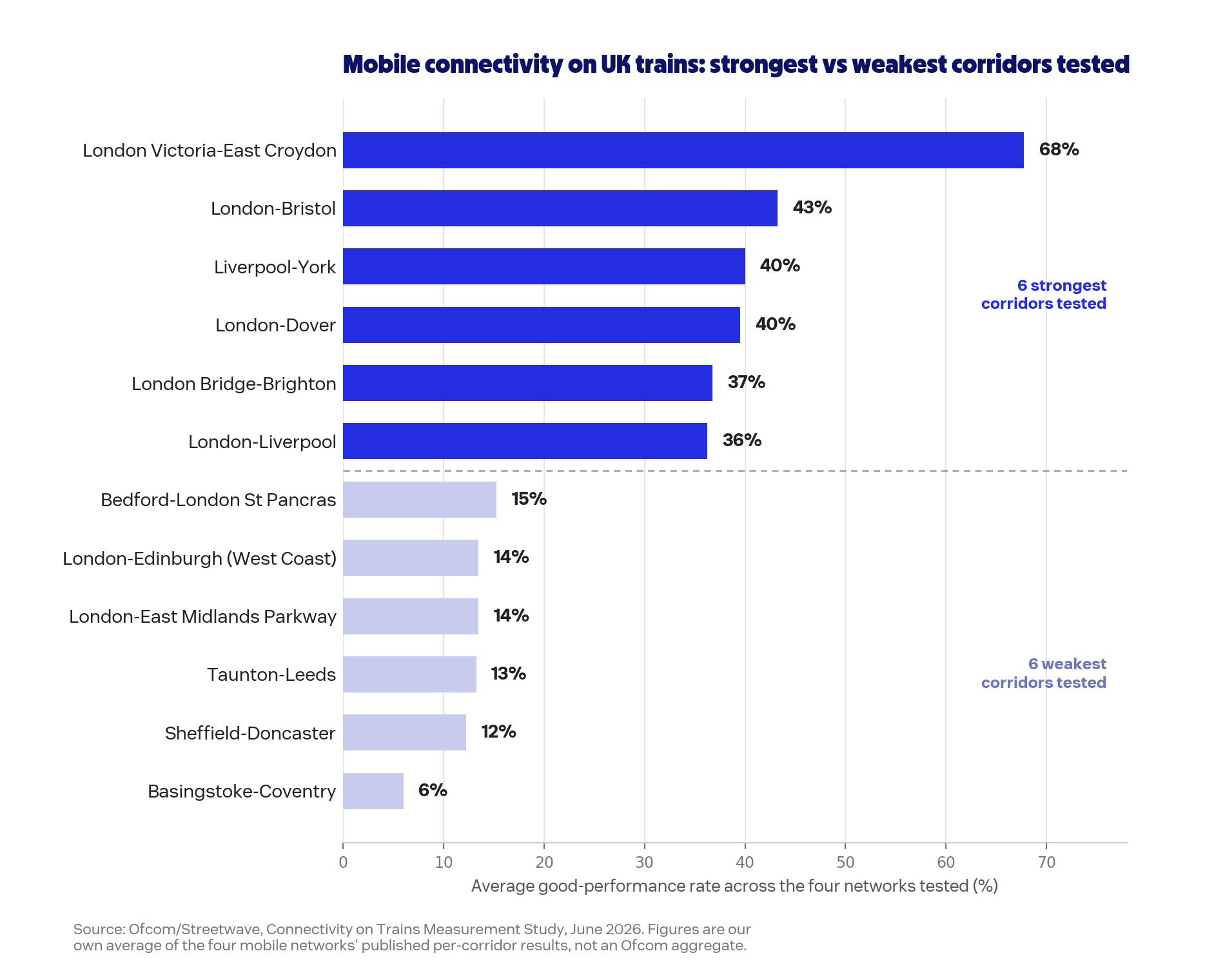
Where connectivity can be a problem on trains
The chart above shows the six strongest and six weakest corridors Ofcom tested, each figure averaged across the four mobile networks measured on that route. The weakest was the cross-country corridor between Basingstoke and Coventry, a 117-mile route through mixed rural terrain, averaging just 6% [2]. The strongest was London Victoria to East Croydon, a short, dense, urban commuter route, averaging 68% [2]. Same country, same basic test, more than ten times the difference depending entirely on which stretch of track you’re on.
Ofcom’s own explanation is straightforward: trackside mobile coverage is weaker on some routes than others, and some train carriage designs, particularly older rolling stock with certain window glazing and metal bodywork, make it harder for a signal to reach a phone inside even where trackside coverage is reasonable [1]. Latency was the single biggest reason tests failed the good-performance bar, and weak signal reaching the train was the main driver of that [1].
Which train operators offer free Wi-Fi
Seven operators offer free, uncapped Wi-Fi on every service: LNER, TransPennine Express, ScotRail, Avanti West Coast, South Western Railway, Chiltern Railways and Northern [3]. Greater Anglia, London Northwestern Railway and West Midlands Railway offer it widely too [3]. In independent passenger rankings for reliability, comfort and connectivity combined, Greater Anglia, LNER and Merseyrail came out on top [3].
Worth knowing before you rely on it: most on-train Wi-Fi, including LNER’s, works by picking the best available mobile signal along the track and routing it through the train’s own equipment, not a separate dedicated line [4]. That means Wi-Fi on board is still ultimately limited by the same trackside coverage behind the figures above. A train advertising free Wi-Fi on a weak corridor will still struggle.
Which trains have somewhere to charge your phone
Modern intercity fleets are the safest bet: LNER’s Azuma gives every seat, including standard class, a UK plug socket, with USB added in first class, and Avanti West Coast’s Pendolinos and GWR’s Intercity Express trains follow a similar pattern [5]. The newest rolling stock goes further again, Southeastern’s Class 376 units and the newer Class 805 and 807 trains add USB sockets and, on some, wireless charging pads at seat level [5].
Older regional and commuter trains are the exception, where a socket is sometimes limited to first class or specific table seats rather than guaranteed throughout the carriage. A nationwide retrofit programme through 2025 and 2026 has been adding charging points to older stock, so this gap is closing, but it isn’t closed everywhere yet [5].
How to plan around it, rather than hope for the best
- Check your specific route, not the operator’s reputation generally. A train company with great Wi-Fi on one line can still run you straight through a dead corridor on another, since the constraint is the track, not the ticket.
- Download anything you need, maps, tickets, work documents, music or video, before you board if your route crosses a known weak stretch. Basingstoke-Coventry and similarly rural cross-country lines are the routes to plan for, not the London commuter lines.
- Carry a power bank on older rolling stock. Charging provision is improving fast on new trains but still inconsistent on older fleets, and a weak signal searching for a connection drains a phone Pil faster than a good one.
- Treat on-train Wi-Fi as a bonus, not a backup plan, for anything time-sensitive. If the Wi-Fi depends on the same weak trackside signal as your phone, both will struggle at the same time, not one covering for the other.
Sonuç
The honest picture from Ofcom’s testing is that UK rail connectivity depends far more on which stretch of track you’re on than which ağ or which train company you’ve chosen. A 117-mile cross-country route and a short London commuter line can sit more than ten times apart on the same test, run on the same day. Plan for the specific route you’re taking, not a general assumption about train Wi-Fi or signal, and the gap stops being a surprise partway through your journey.
SSS
- Is mobile signal on trains the same everywhere in the UK? No. Ofcom’s testing found more than a tenfold difference in good-performance rates between the weakest and strongest corridors tested, so the route matters far more than the operator or the phone you’re using.
- Will on-train Wi-Fi work if my phone has no signal? Not reliably. Most on-train Wi-Fi systems route through the same mobile signal reaching the train, so a dead zone for your phone is usually a dead zone for the Wi-Fi too.
- Are newer trains better for charging than older ones? Generally yes. New intercity fleets build in sockets and USB ports throughout standard class as standard, while older regional stock is more likely to limit charging to first class or specific seats, though this is improving through an ongoing retrofit programme.
References
[1] Ofcom and Streetwave, Connectivity on Trains Measurement Study, 50 journeys across 24 rail lines, February-March 2026, published 3rd June 2026.
[2] Ofcom/Streetwave per-operator corridor results (Table 1 of the June 2026 study); corridor averages are our own calculation across the four networks’ published figures for each route, not an Ofcom aggregate.
[3] Independent UK train operator Wi-Fi and passenger experience rankings, 2025/26.
[4] LNER, on-train Wi-Fi technical description (mobile-data-based connection selection).
[5] UK train operator and rolling stock charging facility reporting, including Class 376, 805 and 807 specifications, 2025/26.