

The UK is banning social media for under-16s. Will it work?
By spring 2027, UK law will stop under-16s holding accounts on TikTok, Instagram, Snapchat, YouTube, Facebook and X, pending a vote expected by the end of 2026 [1]. Australia got there first. Its ban has been running since 10th December 2025, and the government’s own regulator has now published the first independent evaluation of what actually happened [2].
The short version: account numbers fell. Usage barely did.
This piece sets out what Australia’s first year shows, where the displaced usage went, what the UK’s own school phone ban already taught us about restricting access without removing the appeal, how affected teenagers say they feel about it, and what the honest answer is on whether any of this reduces how much time, data or money moves through a phone.
What’s changing, and where
UK: platforms must stop under-16s holding accounts, přepínač off livestreaming and stranger-messaging across a wider range of services including gaming, and apply default overnight curfews (midnight to 6am) and anti-scroll limits for 16 and 17-year-olds. Messaging apps are excluded [1].
Australia: under-16s have been blocked from seven platforms, including Reddit, since 10th December 2025, the first country to actually enforce this rather than just legislate for it [2]. France followed in July 2026 with a ban for under-15s [9].
Nine in ten UK parents and two-thirds of young people say they support some version of this [1].
Does it cut usage?
Three months after Australia’s ban began, the eSafety Commissioner surveyed more than 4,000 children and families, before the ban and again at the three-month mark, the first wave of a two-year evaluation [2].
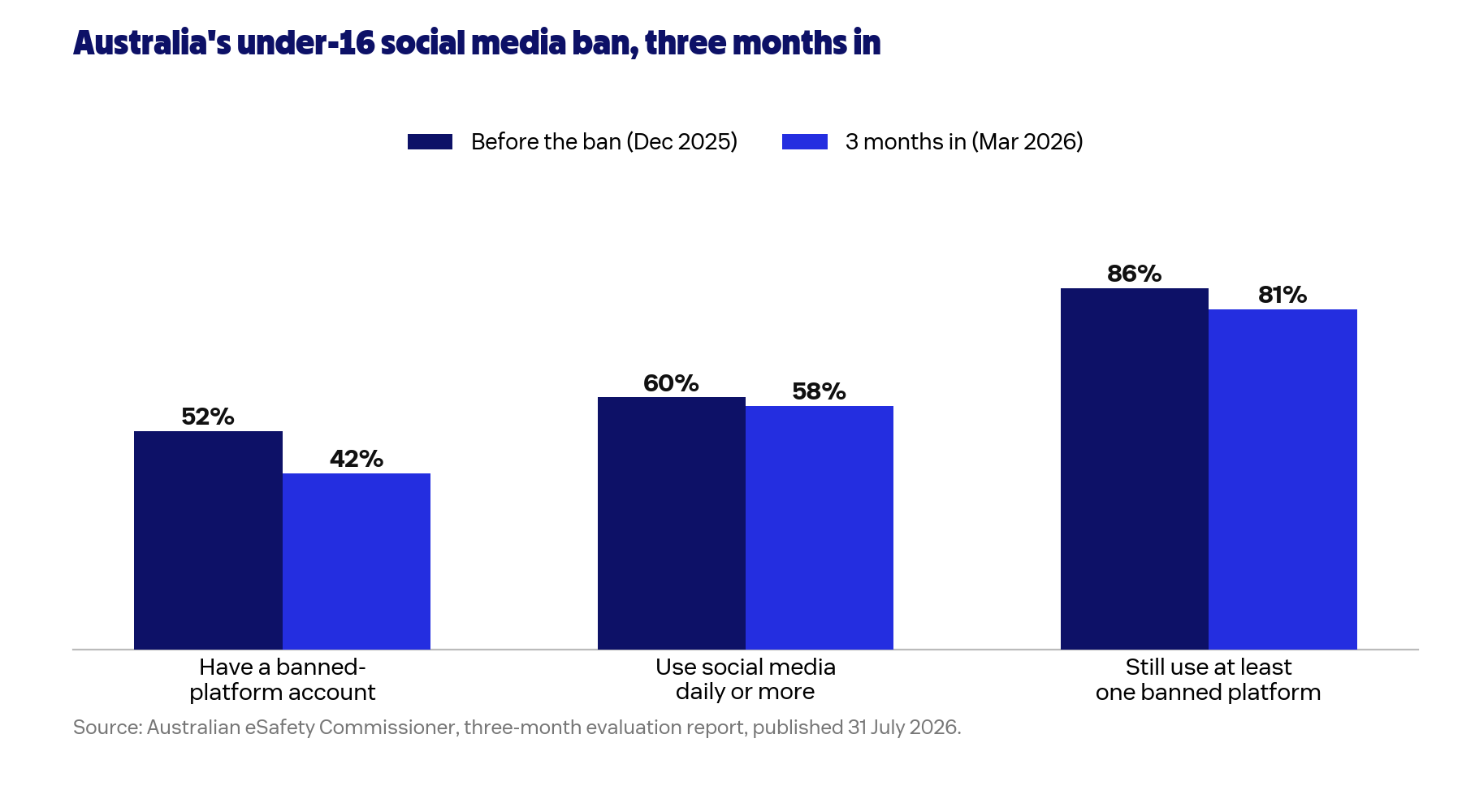
Account ownership fell by ten points, the only one of these three measures to move by a meaningful margin. Daily-or-more usage and still using a banned platform both held close to where they started [2].
The regulator found no meaningful change in time spent on sport, arts, seeing friends, or community activities [2], the things a ban like this is meant to free up room for.
Half of the children who kept their accounts said the platform simply never checked their age. Others said their account already listed them as 16 or older, or that a face-scan system got their age wrong [2].
Where the usage goes instead
On the day the ban took effect, VPN traffic to mezinárodní servers spiked 170% above baseline [3]. That wasn’t a one-off reaction: when Australia separately rolled out mandatory age verification for adult content months later, VPN apps jumped as high as 7th among all free downloads [3].
Messaging and gaming use both rose over the same three months [2]. Reddit, which is inside the ban and is challenging its inclusion in court, saw usage among under-16s rise from 6% to over 9%, with or without an account [2].
For plenty of children the simpler finding holds: the platform didn’t ask, so they didn’t need a workaround [2].
The UK already ran a version of this experiment at school
England’s own schools already showed this: restricting access without removing the appeal doesn’t automatically reduce it. Statutory guidance has barred phone use during the school day since January 2026, up from non-statutory guidance in 2024 [4].
The most rigorous evaluation, the SMART Schools study, followed 1,227 adolescents aged 12 to 15 across 30 schools. Researchers describe a displacement effect: banning phones at school reduces phone use at school, but it doesn’t reliably reduce how much time teenagers spend on their phones once they’re home [4].
That’s the same mechanism Australia’s regulator is now describing at national scale instead of inside a school gate.
How kids say they feel about it
ABC’s Behind the News surveyed more than 17,000 Australians under 16 as the ban began. Around 80% of 9 to 15 year olds said they used social media in some form [5].
“I use it a lot to interact with other people… I was kind of sad about it.” — under-16 surveyed by ABC’s Behind the News, December 2025 [5]
A separate, longitudinal study that’s tracked young Australians’ news habits since 2017 surveyed 1,027 10 to 17 year olds two months after the ban. 61% who’d used a now-banned platform reported little or no change to their own usage. Only 26% said it had actually affected them [6].
For that smaller group, the ban had one clear, measurable cost: 51% said they were now getting less news. Three in four young Australians already said news organisations have no idea what their lives are like, this didn’t help [6].
Not everyone studying this thinks a ban is the right tool
Dr Victoria Nash at the Oxford Internet Institute argues a blanket ban risks leaving teenagers ‘protected’ in name while cut off from news, learning and support. That’s happening at the exact moment the UK is preparing to give 16-year-olds the right to vote [7].
“Banning under-16s from social media won’t stop determined teens from connecting online, but it will encourage them to break the rules or find new, riskier spaces.” — Dr Victoria Nash, Oxford Internet Institute [7]
Her reading of Australia’s data: no discernible reduction in children reporting harm, and no meaningful change in reported cyberbullying or intimate image abuse, the two things the ban was built to prevent [7]. Oxford’s Department of Psychiatry goes further, calling a blanket age ban a ‘blunt tool’ that’s a stronger step than the current evidence supports, arguing platform and AI design matters more than who’s allowed to reach them [8].

What this means for phones, data and plans
This is where the evidence runs out and the reasoning has to do the work.
Nothing in Australia’s first year suggests under-16s are spending meaningfully less time on their phones. The usage that left banned platforms mostly went to messaging and gaming, both of which can carry as much data as scrolling a feed, sometimes more.
If anything, the clearest behaviour change so far is a shift toward VPN apps, which add their own layer of always-on background data use. None of this predicts that UK mobilní data usage among teenagers will rise once the ban lands in 2027. It’s a reason to be sceptical of anyone predicting it will meaningfully fall.
Závěr
Australia’s first year doesn’t prove the UK’s ban will fail. It proves that passing a law and changing how under-16s use their phones are two different projects, and so far only one of them has happened. Whatever the UK version achieves, the evidence so far says it won’t be a quieter phone.
Nejčastější dotazy
- Is the UK ban in force yet? No. It’s passed an initial vote in the House of Lords. A full vote is expected by the end of 2026, with the ban itself starting in spring 2027 [1].
- Does messaging count as social media under either ban? No, both the UK’s plan and Australia’s current law exclude messaging apps [1][2].
- Has the ban reduced cyberbullying in Australia? Not yet, by the regulator’s own data: no discernible change in reported incidents three months in [7].
References
[1] UK Government, “Fact sheet: new rules to protect children online”, gov.uk, announced 15th June 2026; House of Lords vote, 22nd January 2026.
[2] Australian eSafety Commissioner, three-month evaluation of the Online Safety Amendment (Sociální média Minimum Age) reforms, published 31st July 2026.
[3] VPN traffic and app-ranking data tied to Australia’s 10th December 2025 social media ban commencement and its separate adult-content age-verification rollout, reported via TechRadar and other outlets.
[4] UK Department for Education, mobile phone guidance in schools (non-statutory February 2024, statutory January 2026); SMART Schools study, 1,227 adolescents aged 12-15 across 30 UK schools.
[5] ABC “Behind the News” survey of over 17,000 Australians under 16, December 2025.
[6] Longitudinal study of young Australians’ news engagement (ongoing since 2017), survey of 1,027 respondents aged 10-17, February 2026, reported via The Conversation.
[7] Dr Victoria Nash, Oxford Internet Institute, expert comment, January and June 2026.
[8] University of Oxford, Department of Psychiatry, expert comment, June 2026.
[9] France’s under-15 social media ban, approved July 2026, reported via ABC News.