


What age should a child get their first phone? The evidence, not the opinions
Ask a parent what age is right for a child’s first phone and you’ll get a confident answer. Ask five parents and you’ll get five different confident answers.
YouGov’s 2024 survey of over 2,000 UK adults found 51% of parents think 11 to 13 is the right window, 23% would wait until 14 to 16, and 5% would hold out past 17 [1]. Internet Matters’ own back-to-school survey puts parents’ preferred age at 10 [2]. Nobody’s wrong. They’re answering different questions about different children.
We looked at what UK families actually do instead. Ofcom’s data shows a sharp jump between age 10 and 11: ownership goes from 56% to 83% in a single year [3]. That jump sits inside a wider curve.
Here’s what the data shows, why 11 specifically drives the decision, a readiness checklist that matters more than the date on a calendar, and what to set up before handing the phone over.

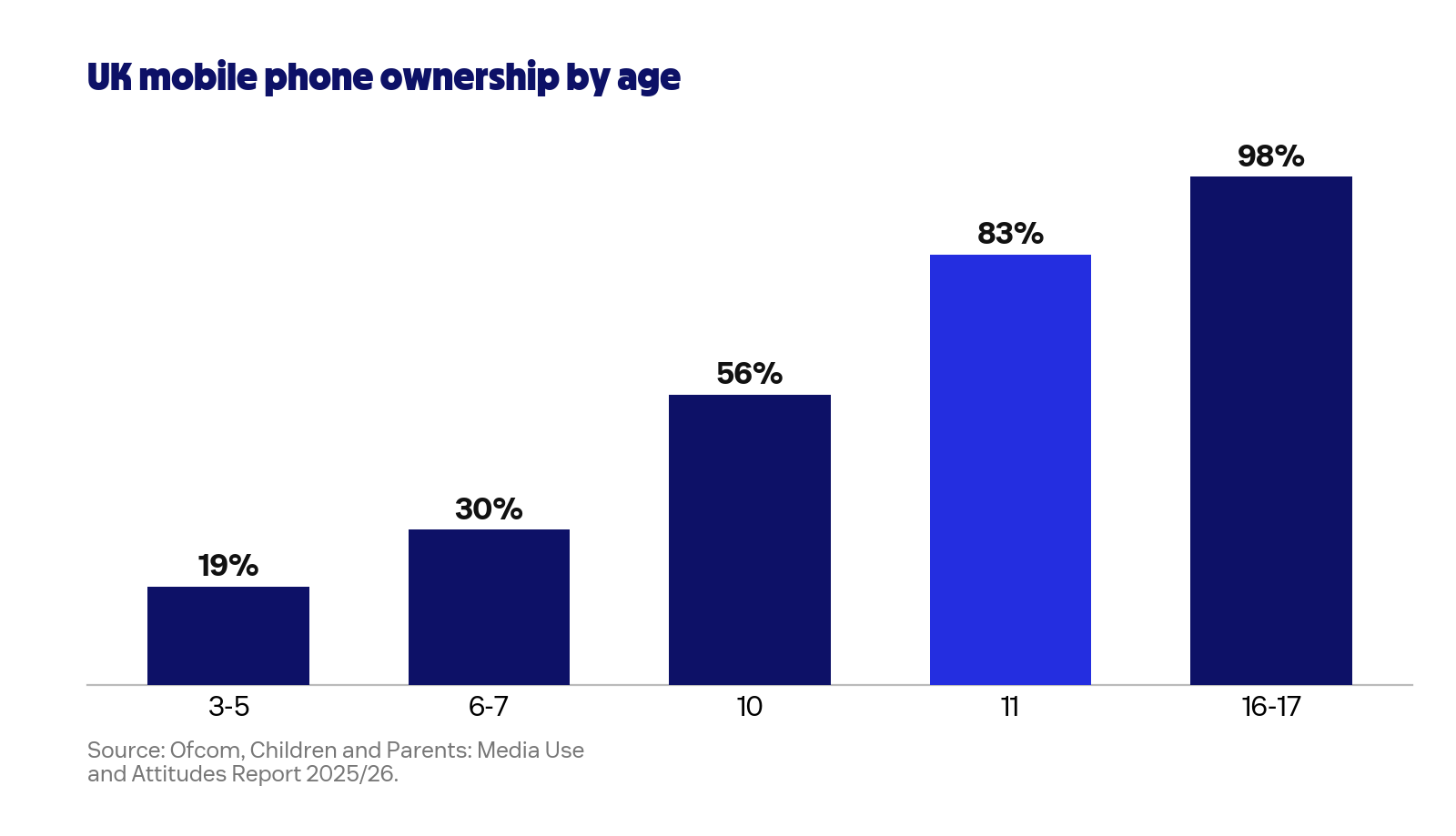
Ownership holds under a third through the primary years, nearly doubles at 11, then edges towards universal by 16 or 17.
Three in ten 6-7 year olds already have their own device [3], so the ‘first phone’ conversation often starts years before secondary school. But ownership as a majority behaviour, something most families are doing rather than a minority choosing early, starts at 11.
The opinion surveys cluster loosely around that same window: 51% of parents call 11-13 ideal [1]. The next question is why 11 specifically, and the answer isn’t a birthday.
Why age 11?
For most UK children, 11 is the year they leave primary school and start making their own way to secondary school, often alone, often by bus. A 2023 peer-reviewed study on parents’ smartphone decisions for 9-12 year olds found this transition, not the birthday, is what triggers the purchase [4]. One parent in the study put it plainly:
“When they come to secondary school, then they start to be more independent… I need to give the smartphone.” — parent interviewed in Journal of Children and Media, 2023 [4]
A child still walking to school hand-in-hand with a parent at 10 doesn’t need a phone on their 10th birthday. A child catching a bus alone at 11 does, the same week term starts. That also explains why the opinion surveys spread out so widely: parents aren’t disagreeing about age, they’re picturing children at different stages of independence and attaching a number to that picture.
Readiness signals that matter more than age
The data says 11 is when most families make the prepínač. It doesn’t say your child should.
Four signals matter more than a birthday: they’re starting to travel independently (walking to school, the bus, after-school clubs alone), they look after belongings without reminders, they understand a phone is a responsibility rather than a toy, and you’ve agreed basic rules before the phone arrives, not after.
Not every child hits these at the same age. Some are ready at 9. Some aren’t at 13. The ownership curve describes what most families do. It isn’t a verdict on what yours should.
In 2018, Dr Jon Goldin, vice-chairman of the Royal College of Psychiatrists’ child and adolescent faculty, told the Daily Telegraph that official guidance on smartphone age would help:
“This guidance would back parents up when they were having conversations with their ten-year-olds.” — Dr Jon Goldin, Royal College of Psychiatrists, via Daily Telegraph, 2018 [5]
That guidance still doesn’t exist. Some child safety campaigners argue for a flat minimum age regardless of readiness, pointing to the age limits already set by social platforms themselves. That’s a fair position. This piece takes a different one: the device and what’s allowed on it are two separate decisions.
What to set up on day one
A basic handset, calls and texts only, no app store, no social media, is often the better starting point for 8-10 year olds who need to be reachable but aren’t ready for the internet in their pocket. A smartphone makes more sense once the signals above are in place, with controls set up before your child turns it on, not after.
Worth doing in the first hour: set content and spending controls through your sieť before handing the phone over, agree which apps go on together rather than letting your child install what they want on day one, and decide where it charges overnight (not the bedroom is a common, reasonable starting rule).
There’s also a legal backstop now, separate from anything you set up yourself. Since July 2025, the Online Safety Act requires platforms likely to be accessed by children to run age checks that are ‘highly effective’, not a tick-box birthdate field, and Ofcom has opened dozens of investigations into non-compliant platforms since [6]. It isn’t a substitute for the controls above. Enforcement is still ramping up and coverage varies by platform, but the responsibility isn’t sitting on parents alone anymore.
Záver
The data settles one thing: 11 isn’t an opinion, it’s what happens. It doesn’t settle whether your child is ready, that’s still yours to judge, using the signals above instead of the calendar.
If a first phone is coming up, a rozpočet entry SIM-only plan with Lebara (5GB link here) with no contract can help you experiment with phone usage while you’re still working out if your child should have a phone and how much data they need. Each Lebara account can manage up to 5 SIMs, so you can track your children’s calls, texts and data usage all from a single device.
To protect young people, Lebara has placed restrictions on access to adult content. You can learn more about how to amend these restrictions tu.
Často kladené otázky
- Is a smartwatch a reasonable in-between step? It’s a common choice for parents not ready for full internet access: GPS tracking and calls without an app store or social media. Worth flagging: most of what’s written about this comes from the smartwatch brands themselves, so treat specific product claims the way you’d treat any vendor marketing. No independent UK ownership data exists to say how widespread this is.
- What’s the youngest age Ofcom records ownership at? Three in ten 6-7 year olds already own one [3].
References
[1] YouGov. “The youngest age British parents think kids should have smartphones.” Fieldwork August 2024, n=2,004 UK adults.
[2] Internet Matters. “Back to school survey reveals parents’ preferred age for their kids to own a smartphone is 10 years.”
[3] Ofcom. “Children and Parents: Media Use and Attitudes Report 2025/26.” Published 21st May 2026.
[4] “Parents’ perspectives on smartphone acquisition amongst 9- to 12-year-old children in the UK.” Journal of Children and Media, 2023. DOI 10.1080/13229400.2023.2207563.
[5] Dr Jon Goldin, via Daily Telegraph, 2018 (dated as historical commentary, not current).
[6] UK Online Safety Act, children’s safety duties enforceable from 25th July 2025, Ofcom age assurance guidance.