
Cum schimbă IA scopul unui telefon mobil?.
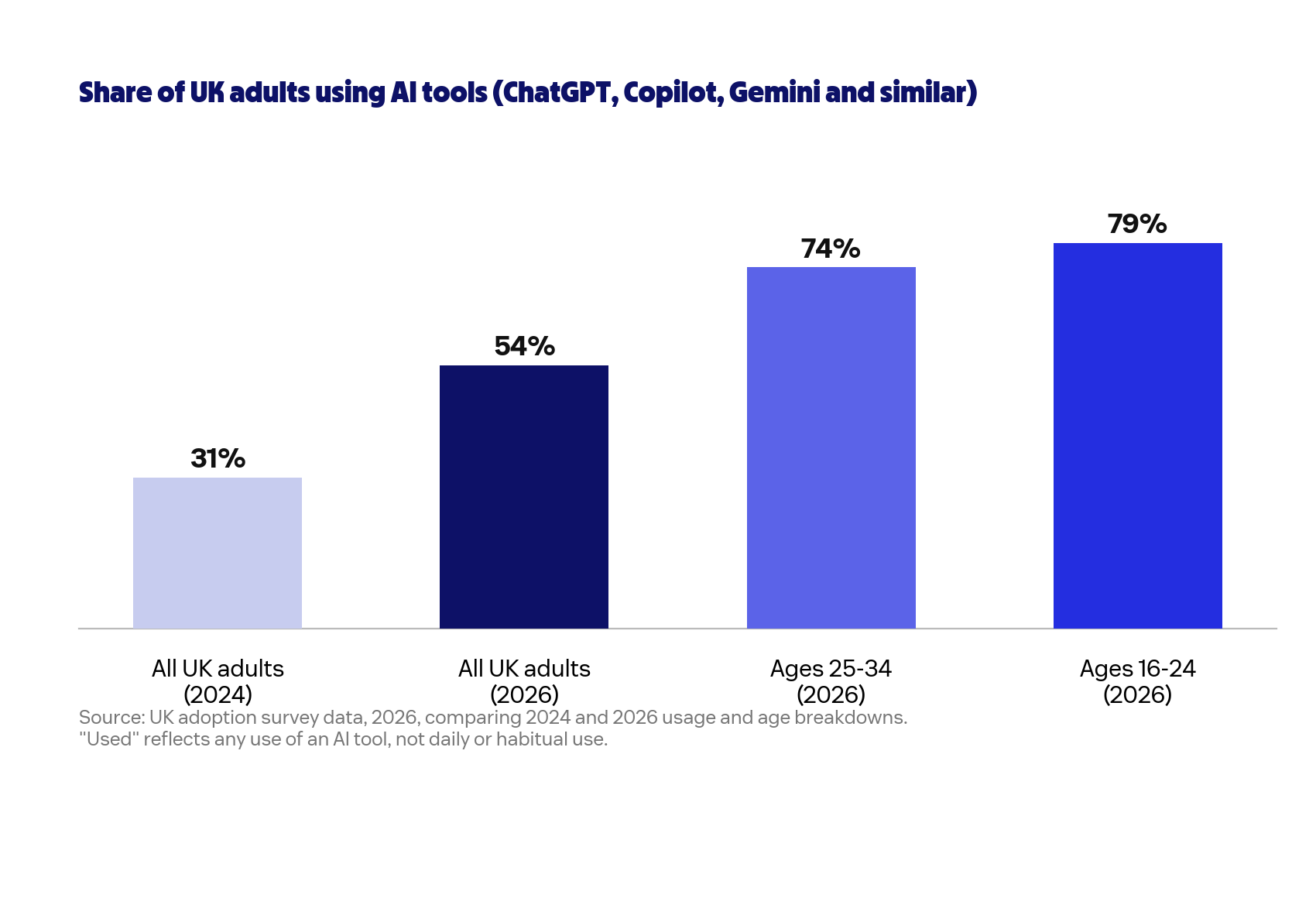
Two years ago, AI tools were a novelty most people had heard of but not opened. That’s no longer true. More than half of UK adults, 54%, now use an AI tool such as ChatGPT, Copilot or Gemini, up from 31% in 2024, and nearly 30 million people in the UK used one in July 2026 alone [1]. Among 16 to 24 year olds, usage is already at 79%. We looked at what that shift means in practice: whether AI is replacing search and asistenți vocali, Cât costă de fapt aceste servicii în materie de date și dacă gadgeturile dedicate pentru inteligență artificială sunt în creștere.

Într-adevăr, IA înlocuiește căutarea?
Not yet, but it’s taking a growing slice. One 2026 consumer survey found 37% of people now begin a search with an AI tool rather than Google [2]. At the same time, the overlap between the two hasn’t moved: 95% of ChatGPT users also use Google, a figure that was identical in September 2025 and May 2026 [2]. The clearest reading of that is addition rather than replacement, people are reaching for AI as a new first step, then often still checking Google, not dropping one for the other.
The shift may still be gathering pace. Gartner has forecast that up to 25% of traditional search volume could move to AI chatbots and agents by the end of 2026, and ChatGPT’s own search feature had reached 700 million weekly active users as of 2026, having launched in October 2024 [2]. Google still accounts for 95.5% of the market among the three most-used mobile search engines, so any shift so far is happening at the margins, not the centre, of how people search on their phones [2].
Asistenții vocali au venit mai întâi, iar majoritatea oamenilor încă îi folosesc pe telefonul lor.
Before the current wave of chatbot apps, voice assistants were most people’s main brush with AI. Ofcom reports 54% of UK adults have used a digital assistant in the past three months, and 41% of UK households own a voice-enabled speaker [3]. But the device doing the listening is usually the one already in your pocket: 91% of voice assistant interactions happen on a mobile device, and smartphones account for 56% of all voice assistant usage, ahead of smart speakers [3]. Siri, Google Assistant and Alexa still dominate by sheer install base, while newer AI-native assistants are growing fastest off a smaller starting point.
Cât vă costă aplicațiile de AI în date
Pentru majoritatea oamenilor, chatul cu o aplicație de AI prin text este una dintre cele mai ușoare activități pe care le poate face un telefon. O schimbare de mesaje tipică are o dimensiune de 2 până la 9 KB per mesaj, iar o conversație de tip back-and-forth durează aproximativ între 1 și 5 MB, aproximativ la fel ca navigarea pe câteva pagini web [4].
The feature you choose changes that considerably. Voice mode, talking to an AI assistant instead of typing, runs at around 60 to 120 MB an hour, closer to a music streaming session. Asking an AI app to generate images or video pushes well past that, into the same range as video streaming, over 250 MB an hour in some cases [4]. If you’re watching a data allowance, the mode matters more than the app.
A ajuns hardware-ul dedicat AI la un nivel acceptabil?
Două încercări timpurii de a crea un dispozitiv AI fără telefon au avut destinuri diferite. Pinul Humane AI, un dispozitiv $699 portabil care necesită o abonament lunar de $24, a fost închis în februarie 2025, după ce Humane a vândut majoritatea activelor sale către HP, lăsând dispozitivele existente incapabile să funcționeze ca produse AI [5]. Rabbit R1, un dispozitiv mai ieftin de $199 fără abonament, este încă în vânzare și primește actualizări începând cu anul 2026 [5].
O nouă categorie apare în jurul dispozitivelor dotate cu SIM tablete construite cu procesare AI pe dispozitiv, în loc de dispozitive vestimentare, precum Ai+ LapTab, anunțată împreună cu 5G, dual-SIM support and a dedicated AI chip for offline tasks like translation. These remain niche compared with mainstream tablets, and it’s too early to say whether cellular AI-first devices become a real category or stay a sideshow to the smartphone [6]. So far, the evidence points the other way: AI is arriving as software on the phone people already own, not a new device replacing it.
Modificările de comportament până acum
People haven’t switched tools. They’ve added one. The same UK adoption figures show most AI use sitting alongside existing habits: people still use Google, still use their regular apps, and have folded an AI tool into the gaps, drafting a message, checking a fact, planning something, before going back to what they were doing [1][2]. Expectations are still rising though: 63% of UK consumers say they expect to use AI more over the course of 2026, and 59% think it will become their main way of finding information eventually, even if it isn’t yet [2].
Întrebări frecvente
- Vor înlocui chatboturile AI Google pe telefonul meu? Nu se bazează pe datele actuale. Majoritatea oamenilor care folosesc instrumente de inteligență artificială încă folosesc și Google, iar Google încă deține cea mai mare parte a activității de căutare pe dispozitive mobile. Întrucât este vorba de o nouă practică, nu de eliminarea unei vechi, AI-ul aduce în prezent un plus.
- Utilizarea aplicațiilor bazate pe IA consumă mai multă bandă de date decât aplicațiile obișnuite? Text-based use barely registers. Voice mode and image or video generation use noticeably more, roughly in line with music or video streaming, so the way you use an AI app matters more than whether it’s installed.
- Sunt gadgeturile autonome de inteligență artificială în valoare de cumpărare în loc să folosesc aplicații de inteligență artificială pe telefonul meu? Performanțele până acum sunt mixte, cel mai bun exemplu fiind dispozitivul standalone de ultimă generație cu IA. Unul dintre cele mai proeminente dispozitive autonome cu IA a încetat să funcționeze complet în termen de un an de la lansare. Pentru majoritatea oamenilor, o aplicație de IA instalată pe un telefon pe care îl au deja rămâne opțiunea mai fiabilă.
Concluzie
AI use on handsets has gone from a minority habit to a majority one in two years, and it’s still growing fastest among under-35s. It hasn’t replaced search, voice assistants or the smartphone itself. It’s layered on top of all three. The practical takeaway for anyone on a limited data plan: text-based AI use costs you almost nothing, voice and image features cost considerably more, and for now, the phone in your pocket remains the device doing the work.
Referințe
[1] Date din sondajul privind adoptarea instrumentelor AI din Regatul Unit, 2026, raportând creșterea anuală de la 2024 la 2026 și detalii pe categorii de vârstă.
[2] Sondaje privind adoptarea AI în căutarea de informații și date privind utilizarea platformei, 2026; prognoza Gartner privind ponderea volumului de căutare realizat de chatboturile AI; date privind ponderea pieței motoarelor de căutare mobile, 2026.
[3] Ofcom, raportând despre utilizarea asistenților digitali și a dispozitivelor cu funcție de voce în Marea Britanie, inclusiv o analiză detaliată a interacțiunilor cu asistenții vocali la nivel de dispozitiv.
[4] Analiza consumului de date al aplicației ChatGPT pe funcții (text, modul de voce, generarea de imagini/video), 2026.
[5] Humane Inc., anunț privind închiderea serviciului cloud, februarie 2025, în urma vânzării activelor către HP; Rabbit Inc., starea continuă a suportului pentru dispozitive, 2026.
[6] Ai+, LapTab Anunț privind produsul, noiembrie 2025, pentru lansarea prevăzută în primul trimestru al anului 2026.