


Do payment apps give you a better exchange rate?
Traveller’s cheques are already history: American Express stopped issuing new ones on 31st December 2020, two decades after sales peaked in 2000 [1]. The bureau de change hasn’t disappeared in the same way, but the sector has thinned out: 국제 Currency Exchange, once a major UK chain, put its 26 bureaux into administration in October 2021, costing 119 jobs [2]. Meanwhile UK cardholders spent £3.7 billion outside the UK in March 2026 alone, up 6.6% on the year before, across 157 million transactions, up 9% [3].
The obvious conclusion is that apps and cards have simply taken over. We looked at what’s changed, and the real picture is messier and more useful: most people still travel with cash as well as a card, and having a card doesn’t automatically mean a better deal.
Cash hasn’t gone away
69% of UK travellers still use cash when they’re 해외, according to an industry report published in March 2026, and a separate ABTA survey found Britons carry more cash on holiday than they do at home [4]. Card and cash use have grown together rather than one replacing the other: contactless now accounts for 67% of credit card and 76% of debit card transactions overall [3], but a card that doesn’t work at a small vendor, a market stall or a tip jar still leaves you needing some physical currency.
The Post Office remains the UK’s largest travel money provider by footprint, with services available from more than 11,000 of its branches [5]. Its own demand hasn’t disappeared. What’s changed is where that demand is met: a growing share of its travel money is now ordered online or through its own app rather than exchanged over a branch counter.
What you pay above the mid-market rate

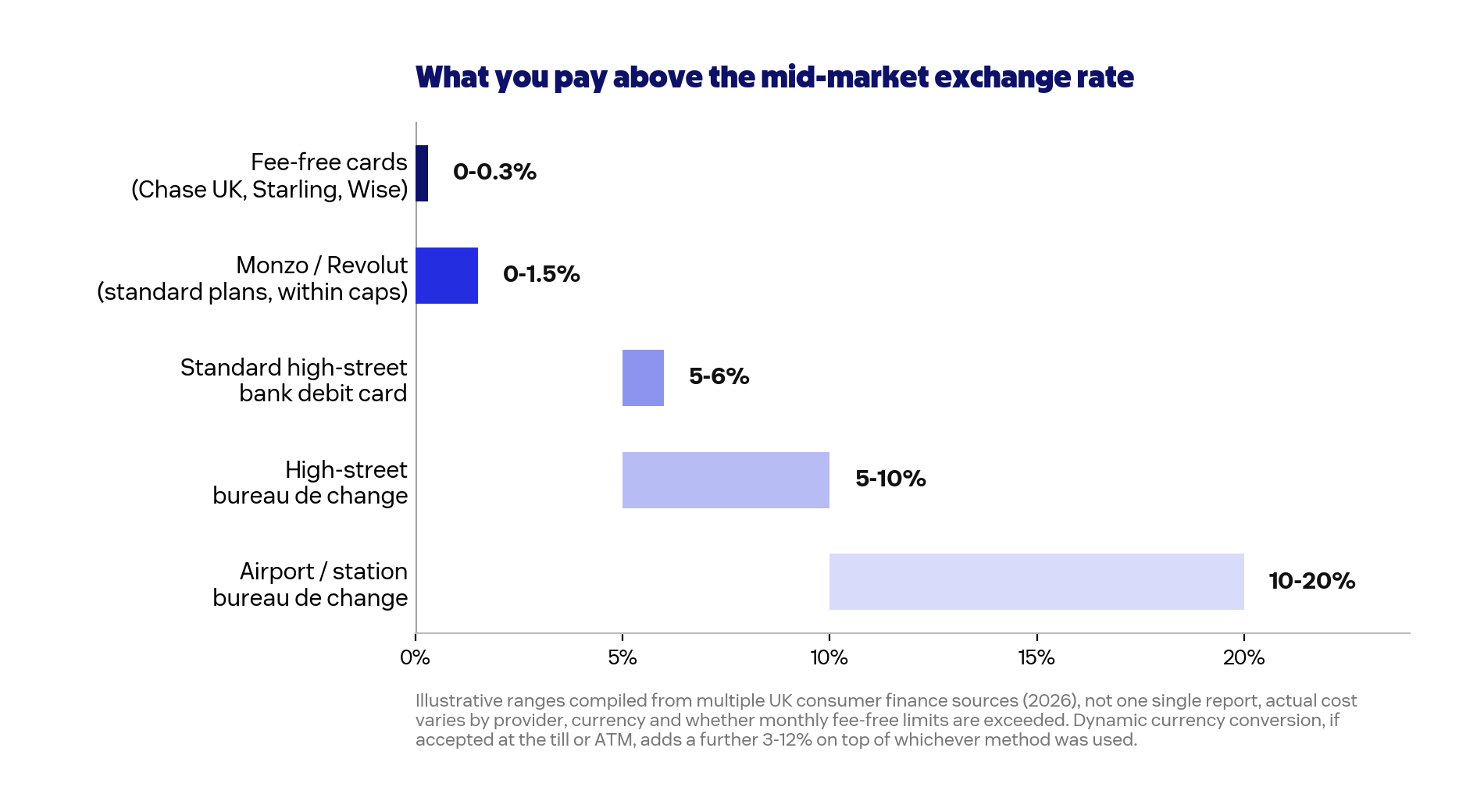
Every currency has a mid-market rate: the real, benchmark rate banks trade with each other at, with no margin added. Every method of getting foreign currency adds a markup on top of it somewhere, the question is how much.
A small number of UK cards now charge close to nothing extra. Chase UK applies zero foreign transaction fees and converts at the Mastercard exchange rate with no markup, plus free ATM withdrawals up to £500 a day and £1,500 a month [6]. Starling offers unlimited fee-free card spending abroad and fee-free ATM withdrawals worldwide, with a £300 daily ATM limit [7]. Wise charges a transparent fee of roughly 0.43-0.7% on top of the mid-market rate, varying by currency, with no hidden markup in the rate itself [8].
Monzo and Revolut sit just behind these. Monzo gives the mid-market rate (via Wise) with a small flat fee plus up to 1.3% depending on currency [9]. Revolut is fee-free on currency exchange up to £1,000 a month on its Standard plan, then adds a 1% markup at weekends and on public holidays specifically, a detail worth knowing if you tend to exchange money on a Saturday [10].
An ordinary high-street bank debit card is the one that catches people out. Barclays and Lloyds both charge 2.99% on non-sterling transactions, HSBC and NatWest charge 2.75%, and that’s before the 2-3% margin typically built into the exchange rate itself [11]. All in, a standard debit card from a mainstream high-street bank can cost nearly as much as walking into a bureau de change, despite feeling like the modern option.
Bureaux de change sit at the expensive end, often advertised as commission-free, because the markup is built into the rate instead. High-street branches typically run 5-10% above the mid-market rate, airport and station bureaux 10-20% [12]. One mystery-shopping comparison converting £600 into euros found online providers charged around £525 for the same amount, high-street banks £555-563, and an airport bureau £593, a £68 difference for making the exchange in the wrong place [12].
The one mistake that cancels out a good card
Dynamic currency conversion, the option a card terminal or ATM abroad offers to charge you in pounds instead of the local currency, overrides whatever rate your card would otherwise give you. It typically adds 3-12% on top, UK travellers lose an estimated £300 million a year to it [13]. The fix costs nothing: always choose to pay or withdraw in the local currency, never your home currency, whatever the screen suggests as the “easier” option.
Apps worth considering before you travel
Chase UK — Zero foreign transaction fees, Mastercard exchange rate with no markup, fee-free ATM withdrawals up to £500/day and £1,500/month, plus 1% cashback on spending.
Android: https://play.google.com/store/apps/details?id=com.chase.intl
iOS: https://apps.apple.com/us/app/chase-uk/id1517121245
Starling Bank — Fee-free card spending abroad and fee-free ATM withdrawals worldwide, no monthly cap, £300 daily ATM limit, mid-market exchange rate every day including weekends.
Android: https://play.google.com/store/apps/details?id=com.starlingbank.android
iOS: https://apps.apple.com/us/app/starling-mobile-banking/id956806430
Wise — Transparent fee of roughly 0.43-0.7% on the genuine mid-market rate, built for holding and spending multiple currencies rather than just UK current account banking.
Android: https://play.google.com/store/apps/details?id=com.transferwise.android
iOS: https://apps.apple.com/us/app/wise-ex-transferwise/id612261027
Monzo — Mid-market exchange rate via Wise, small flat fee plus up to 1.3% depending on currency, free EEA ATM withdrawals up to £200/month on the Standard plan.
Android: https://play.google.com/store/apps/details?id=co.uk.getmondo
iOS: https://apps.apple.com/us/app/monzo-bank-mobile-banking/id1052238659
Revolut — Fee-free currency exchange up to £1,000/month on weekdays, 1% markup at weekends and on public holidays, ATM withdrawals free up to a monthly limit that varies by plan.
Android: https://play.google.com/store/apps/details?id=com.revolut.revolut
iOS: https://apps.apple.com/us/app/revolut-send-spend-and-save/id932493382
Managing money from your handset, beyond the exchange rate
Freeze and unfreeze a card instantly from the app rather than phoning the bank if it’s 잃어버린 or acting strangely, most of the apps above support this. Turn on instant spending notifications so an unfamiliar transaction shows up in seconds rather than on a statement weeks later. Where the app offers a virtual or single-use card number for online purchases, it keeps your real card number out of circulation entirely.
Setting a lower-than-default daily spending or withdrawal limit before you travel, then raising it only if needed, is a smaller but useful habit: it limits what a cloned card or a 도난 phone can do. Splitting a shared bill through the app rather than carrying the full amount in cash reduces how much any one person needs to hold at once.
None of this works without a 신호. A banking app you can’t open because you’ve got no data abroad is no better than a card you’ve left at home, so it’s worth checking your network’s roaming allowance or getting a travel data add-on sorted before you go, not after you’ve landed and found yourself locked out.
결론
The apps that beat traditional currency exchange are the ones built to do exactly that: Chase UK, Starling and Wise use the mid-market rate with little to no markup. Monzo and Revolut come close within their free limits. An ordinary high-street debit card, the one most people already carry, doesn’t automatically qualify just because it’s a card: once its foreign transaction fee and rate margin are added together, it can cost nearly as much as the bureau de change counter it’s supposed to have replaced.
자주 묻는 질문
- Do I still need to tell my bank I’m travelling? Mostly no. Modern fraud detection tracks spending patterns rather than relying on advance notice, and apps like the ones above let you see and manage activity in real time regardless. A small number of older accounts still recommend it, check your specific provider if unsure.
- Should I still take some cash? Most people do. It’s the only reliable backup if your card is declined, your phone dies, or a vendor simply doesn’t take cards. A small amount for emergencies is reasonable, carrying your whole holiday 예산 in cash isn’t necessary with any of the cards above.
- Is it ever worth using a bureau de change at all? Mainly for speed or when a fee-free card isn’t an option, not for the rate. If you are using one, a high-street branch booked in advance is consistently cheaper than an airport or station counter [12].
References
[1] American Express, discontinuation of Travelers Cheques and Gift Cheques, effective 31st December 2020; sales peaked in 2000.
[2] International Currency Exchange (ICE) UK, administration filing, October 2021, reported via Eastern Eye and company records.
[3] UK Finance, Card Spending Update, March 2026 release.
[4] TravelFX industry report, March 2026, “69% of travellers still use cash abroad”; ABTA consumer survey, “Travellers use cash more when on holiday than they do at home”.
[5] Post Office Limited, Travel Money service branch 네트워크 data.
[6] Chase UK, published foreign transaction and ATM fee terms, 2026.
[7] Starling Bank, published foreign transaction and ATM fee terms, 2026.
[8] Wise, published 전송 and card fee schedule, 2026.
[9] Monzo, published foreign exchange fee terms (via Wise), 2026.
[10] Revolut, published Standard plan currency exchange terms, 2026.
[11] Barclays, Lloyds, HSBC and NatWest, published non-sterling transaction fee schedules, 2026.
[12] UK consumer finance comparison reporting on bureau de change margins and a mystery-shop comparison converting £600, 2026, compiled from multiple sources rather than one single report.
[13] Reporting on UK consumer losses to dynamic currency conversion, estimated at £300 million a year.